
I Moved to Canada - Now What?
On July 2025, I accepted a job offer in Canada, and on the 23rd of August 2025, I landed in Canada. Despite the mixed opinions surrounding Canadian immigration, and my hawkishness against leaving South Africa, I came to a decision to try out a move to Canada. I was not "hypnotized" into the glossy and beautiful image that TikTok and Instagram content creators paint of the expat life. In this post, I want to speak of my reasons for leaving South Africa, life in Canada so far, and provide practical tips and considerations for anyone wondering. My intent is not to regurgitate the vast body of immigration-related knowledge, nor to persuade you into staying put or consider a move.
The Precursor to Emigration
For a while now, I always had the idea of moving to Canada at the back of my mind, but I always had been against the idea. This sounds weird, more so given how it seemingly is fashionable to emigrate from South Africa to a developed nation. The short story is, I understood that my life in South Africa was pretty good, and that every country has its fair share of advantages, and disadvantages. As a tech professional in South Africa, my net worth was already in the top 5–10% of South Africans. South Africa does have problems, like many other countries, but I did not believe that such problems were a hinderance to my life. As an upper-middle-class South African, I was, in a way, living in a bubble, kissed by the amazing sunshine and atmosphere of Cape Town and The Republic of the Western Cape (Western Cape separatists please pipe down, this is shade!).
Over the last year and half, the idea of applying for the expat experience began percolating. "Do you really want to upend your life this?", "Do you understand the gravity of making such a decision?", "The global economy is being held together with bobby pins and prayers, are you sure about this?" and "Okuhle... honey, make up your mind! You are not going to be young forever, and you have BEEEEEN dragging your feet on this matter for 84 years now!" – these were some of the thoughts firing in my mind from time-to-time. After much thought, and having invoked the notwithstanding clause on my life (this is a Canadian reference), I threw down the gauntlet and started turning the wheels of emigration. I got a job offer in July 2025 and left South Africa on the 22nd August 2025. In the words of Whitney Houston, I do have the receipts to substantiate my claims, don't make me pull 'em up! (source to famous clip)
Why Canada?
Choosing Canada as a destination was an easy choice. My hesitation to move was more on the mixed opinions surrounding Canadian immigration, together with my initial assessments of my current life, and the fear of downward mobility.
I chose Canada because I am already a Canadian citizen! The short story is, my late father was a Canadian citizen, and based on Canada's rules for citizenship by descent, I was eligible to claim Canadian citizenship. My father spoke fondly of his time living and working in the province of Alberta. In October 2019, I sent my application and the supporting evidence to the High Commission of Canada in Pretoria. The High Commission reviewed my application package and sent the paperwork to the Case Processing Centre in Sydney, Nova Scotia. In June 2021, Immigration Refugees and Citizenship Canada (IRCC) approved my application and sent my Canadian citizenship certificate and later, my Canadian passport, to the High Commission of Canada in Pretoria, South Africa. I could officially claim my spot at the "dual citizens" table!
Even after officiating my immigration status in Canada, I still was against the idea of moving, for pragmatic reasons.
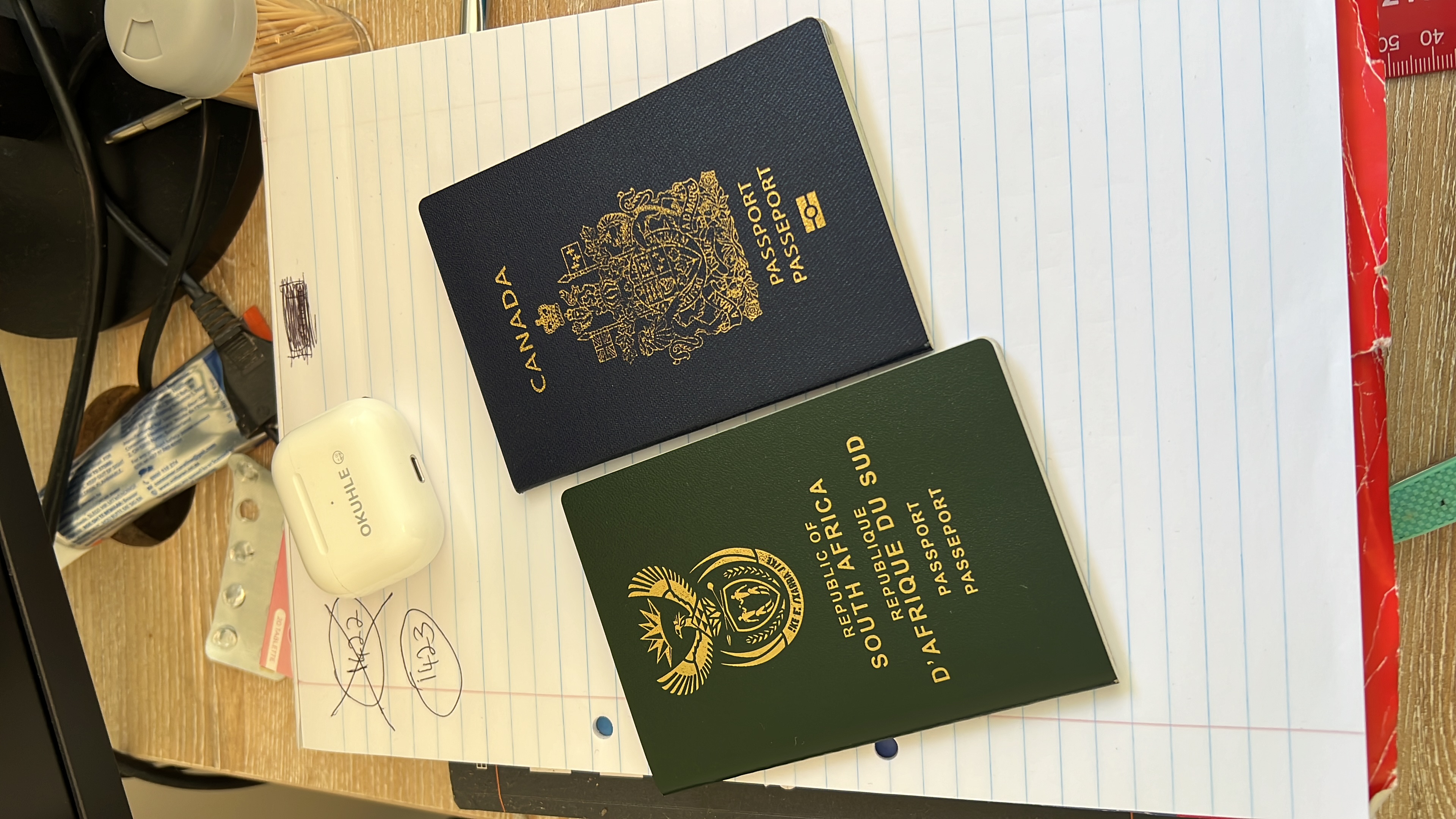
Becoming a dual citizen of South Africa and Canada in 2021 was so cool!
SIDE NOTE: This is where I learnt that embassies/consulates use the diplomatic bag to send official documents and other consignments to their home country. The immigration official at the High Commission did mention that my application was sent via the diplomatic bag. Under Article 27 of the Vienna Convention of Diplomatic Relations of 1961, the diplomatic bag enjoys many privileges, including immunity from detention from any foreign governments.
Why Move If Life was Good in South Africa?
I will admit that my life in South Africa was pretty good, and perhaps, it could have been better. I simply left South Africa so I could experience what life is like, being an expat and having to work through the many challenges associated with moving. You could frame this as an experiment with a sizable upfront cost. I also felt like life is too short for me to be doing the same thing every week and not moving the needle forward.
This sounds weird because many South Africans seem to cite corruption, crime, rolling blackouts, and career advancements as their reasons to leave South Africa. None of these were reasons for me to leave. These are some of the rebutals I had when I considered each point.
- Corruption is everywhere, whether you like it or not. Corruption simply takes resources away from communities that need it the most. In my upper-middle-class lifestyle, the effects of corruption barely affected my quality of life in South Africa - no tea, no shade.
- Crime is a real problem in South Africa, but it was not my reason for leaving. I have been a victim of crime – robbed twice in my life. Exercising a high degree of caution and staying out of trouble is a good way to avoid crime. I have been a conservative, "Good Judy" most of my life anyway.
- As someone who has worked for 6 years now, I do feel that career advancement is subjective and is not always tied to a new country. Career advancement could mean different things to different people. In my view, the modern day career cannot always be expressed as an increasing linear function. A more fitting analogy of the modern day career could be the classic machine learning model that overfits the problem it tries to generalize.
- Rolling blackouts indeed are a problem and has probably caused a sizable drag on the South African economy. However, many wealthy South African households have installed, or are in the process of installing alternate power sources. I may have considered similar approaches.
My intent is not to sound tone-deaf to societal issues. Rather, it is to acknowledge the privilege I had. My reasons and rebuttals do not serve to invalidate other people's perspectives on their life decisions. Everyone is different.
How I got Started
I kicked off the job search process in February 2025. I mainly used LinkedIn Jobs board to look for jobs that were a strong match to my skills offering. What I mean by this is, if you are a C# developer, you should only be applying for C# roles that present something to learn. Your qualifications and experiences should closely align with those of your prospective employer. I also understood that the search would take a while (I explain further down in the post).
I also decided I would handle everything relating to the application process. I could have used a recruitment agency that specialises in cross-border employment, but decided not to look into that option. I had interviews at a few companies while based in South Africa, which I thought was a good thing. Because Metro Vancouver was 9 hours behind South African time, it was strange having to interview at 7 PM, 6:30 PM, and 7:30 PM in the evenings. I recall having to take a shower and drink water before stepping into these interviews since they were held after South African business hours.
The Reality of Immigration
In the first 3 months of living and working in Canada, I experienced a range of feelings such as excitement, anxiety, accomplishment and loneliness. Small wins during this time include collecting my first Canadian paycheque, managing money well (having dollars left over to invest and save), getting full provincial healthcare coverage after completing the waiting period, and feeling a sense of acceptance from my new colleagues. The anxieties I had were tied to my decisions as well as missing the familiarity of Cape Town. While I was able to land a Software Developer job before moving, and that the people I work with are nice and supportive, my evil "tin hat-wearing" angel has always kept me in the "you are still in a precarious situation, honey" box. Although I am doing well, there are still a few unknowns which kind of thwarts my predictive capabilities. These feelings were what I expected before leaving the shores of South Africa, so there is no shock here.
What was a shock to me is how so many skilled immigrants in Canada are working in jobs that do not utilize their skills. The Uber driver that picked me up from the Vancouver International Airport said he was a Medical Biologist in his home country before moving to Canada, and mentioned some of the struggles he faced. What I liked about his story was his ability to pivot into an entirely different industry while having a family to support (he did show me the receipts). The resiliency and bravery of this driver was something to take note of. Similarly, at one of the tech meetups I attended, I recall one of the attendees spoke of how they had sent 500 applications with no interviews, and they were in their sixth month of their job search. These stories, and many others, are part of the broader problem that the Bank of Canada spoke of in 2024: Canada's productivity problem.
I am by no means trying to bash anyone or any country. As a newcomer, you should be prepared for some 'turbulence'. There will be good times and not-so-good times – you need to accept both. I like the "hope for the best, but be prepared for the worst" mantra.
Some Funny Discoveries of Life in Canada
Having moved to Canada, there were some things that took me by surprise, in a humorous way. To my Canadian readers, I mean no harm!
The Fax Machine is Still Alive in Canada!
I thought the fax machine fizzled with time. In Canada, the fax machine is still alive! When I went to see a doctor, I thought I misheard the doctor when he said: "I will fax your documentation to the next doctor." In my head I was like, "The fax machine?! In 2025?! Whew chile the ghetto!". The last time I saw a fax machine was when my father had a desktop computer (230MHz CPU, 128MB RAM) running Windows 98. This was the same PC my mom used to show me how Microsoft Word works.
The Paper Cheque is Still Alive in Canada!
I was also surprised to see physical paper cheques still being used. I had not seen an actual cheque since the days South African stores stopped accepting them in the mid 2000s. Long story short, a few unscrupulous South Africans wrote cheques they could not cash, and businesses were not having any of that! In Canada, one of my medical claims was successfully processed and paid. I initially thought the claim would be deposited into my bank account. To my surprise, a paper cheque with the refund amount was mailed to me in the post. I gagged at seeing a paper cheque – I thought it was diabolical!
Wire Transfers attract high banking fees in Canada!
This one took me by surprise. In South Africa, the go to standard for sending money to other people is wire transfers (aka, EFT – Electronic Fund Transfers). EFT's are free of charges. When I tried to move money between my Canadian bank accounts, I was gagged when I was charged $20 CAD for the wire transfer. Though, the go to standard in Canada is to send Interac e-Transfers, which is fast and free, even if both parties use different banks. I do love using the e-transfer feature.
0% Interest Rate Savings Account Exists!
This took me by a big surprise. In South Africa, savings accounts typically offered interest rates of around 1% - 7%, and South African High Yield Savings Accounts could offer in the region of 9% - 10% interest. In Canada, SO MANY savings accounts offer interest rates of 0.0% - 1%. High yield savings account seems to be any solution that offers interest rates just above the 1.5% mark. One thing is clear – my emergency savings in Canada should not be as big as what I had while in South Africa. I would always hear YouTube content creators speak of U.S savings accounts and how bad the interest rates were on those - I never thought I would see it for myself.
Days are Short in the Winter!
This threw me off big time. In the fall and winter, days are shorter than what I had been used to in South Africa. I am always gagged at how it is already dark by 4 PM. I recall a time when the mornings were dark too, though this gets a little better after day-light savings adjustments kicked-in. You could go the office in dark, and leave the office in the dark! Night running has helped me adjust to this new reality.
The Good Things I Like About Canada
From the few months I have been here, there are many, simple and small things that I like about life in Canada.
The Beautiful Parks, Beaches and a sense of Community in Vancouver
Canada also has some beautiful parks and beaches. I loved running and walking down Stanley Park and the Seawall in downtown Vancouver. Burnaby also has a few nice parks to jog at or go for a walk. In a few years, I would love to walk or run at these beautiful parks with a Golden Retriever, like that woman who owns 51% of her husband's company. There are also many communities in Vancouver. From the post-coffee chats after the weekly Saturday ParkRun's, to the weekly social run clubs and bi-weekly tech meetups (I need to get back to the tech meetups now that I have adjusted to the wet Vancouver). I was inspired by an elderly couple from the United Kingdom who said that for each letter on the alphabet, they have been to a corresponding parkrun in multiple countries - the receipts were the custom shirts they wore! Parkrun tourism is definitely something I want to try!

Running along the Seawall in Vancouver in the summer was so refreshing!
Evening Jogs are Exhilarating
There is something addictive and exhilarating about jogging in the evenings. I even got a nice headlamp to wear for my evening jogs. The nice runs, bundled with the fresh, cool air and Vancouver rains, make my evening runs very satisfying. I will say that having waterproof shoes does help - just don't run into too many puddles. If I were still in South Africa, I would have not dared to jog in the evenings – no tea, no shade.
The Ease of Signing Up For Provincial Healthcare and Getting my BC ID
I loved how easy it was to sign up online for my BC ID (British Columbia ID) and my BC services card. I initially thought I may have to spend half a day at a government office to do all this. The only thing I had to go to an office for was to get my government ID photo taken.
Canada's Public Health System
I would also like to add Canada's publicly funded healthcare system to the list of things I like. While the system has its fair share of problems, and there are discussions and efforts underway to improve it, I still think that it is pretty cool that you can get medical care without worrying about going bankrupt or having to cover shortfalls because your medical coverage plan has lists of in and out of network doctors and hospitals that you can or cannot use. For example, an admin staff member at private hospital could say: "The hospital is part of your healthcare insurance list of in-network hospitals, however, the doctors that treated you were not in-network doctors therefore your medical procedures were not covered by your healthcare insurance plan". According to the Mirror-Mirror report, the United States still wears the crown for the worst performing healthcare system, despite the U.S having the world's most expensive healthcare system.
SIDE NOTE: If interested, I unearthed some aspects of the South African private-private healthcare system and its problems in another project. This was an interesting project where I learnt more about the fractured state of healthcare in South Africa and what other countries have done. The model used in the Netherlands healthcare system was interesting - equalization payments across healthcare insurers so as to discourage the act of 'risk selection' / 'client selection' (see: https://doi.org/10.1111/1475-6773.13065).
Canadians are Friendly
I would also like to add that people in Canada are generally friendly. By friendly, I mean that they're always willing to help. As someone who has had their walls up, it was refreshing to have received so much help from my fellow Canadians – from showing me around town, taking me to IKEA and Costco (that 'after-tears' $1.50 hotdog settles nicely), going to good Asian restaurants (my newly established love for Vietnamese style coffee came from here), and helping me build my first gaming PC. I learnt how to make Miso soup, and also played badminton for the first time while in Canada, so there's that! I hope to fit a ski trip sometime early 2026 in the beautiful mountains that surround the Metro Vancouver region (Mt Seymour I am looking at you). I hope someday I can help another newcomer the same way I was helped.
The SkyTrain and Bus System makes Metro Vancouver Feel Closer Than Ever
I really enjoy using the SkyTrain and bus system to travel to other cities within the Metro Vancouver area. In some cases, I have found the SkyTrain to be faster than Uber / Lyft for the same distance. It was also interesting to learn that the SkyTrain is generally unmanned. As of writing this article, there are plans in motion to expand the SkyTrain network to Langley, British Columbia.
Tips for Newcomers Thinking of Moving to Canada or Those Who Have Already Moved
Here are some tips which I think might be useful for anyone wishing to move to Canada (or any other country). This passage of text is not absolute, therefore, readers should consider & adapt to their circumstances.
Try and Land a Job Offer Before Moving
I do acknowledge that perhaps I am speaking out of line here, given the "unfair privilege" I have. However, I will say that if possible, try and land a job before moving to Canada (or any other country). The reality is, landing a job as a newcomer in Canada and many other countries is tough - you have the following obstacles in your way:
- The highly competitive job market in 2025/2026 means that it may take a few days to 1 year to find employment. Do not underestimate this, and keep this reality in mind.
- Understand that different organisations have different needs, processes and policies in place.
- The lack of Canadian professional networks and references adds more complications to your job search. And by professional connections, I mean people you know personally. With time and networking, this should be rebuilt over time. This does not mean it is the end of the road, it just means that more time & effort may be required.
- I would also suggest to be cautious when using recruiting sites / agencies. Not all of them are good actors.
Money Management Does Not Have to Be Complicated
When I landed in Canada, it was interesting to see how Canada's big banks have newcomer-friendly banking solutions that offer generous credit limits. Although providing easy access to banking solutions for newcomers is a good thing, I cannot help but imagine how many people could easily find themselves buried under expensive credit card debt. In my case, I did not qualify for any of the newcomer-friendly banking solutions since they are limited to Canadian work-permit holders, students, or PR holders – nothing for me seeing as I am a Canadian citizen, though new to living and working in Canada. This exclusion is not a train-smash as I was able to sort myself out with a more conservative banking solution.
I would also recommend you avoid taking out contract-based phone plans / devices. When I landed in Canada, I was able to get a low-cost prepaid e-SIM through Lucky Mobile, and later transferred my number to Freedom Mobile. No bill shocks and surprises. I would also suggest slowing down the rate at which you burn money for the first portion of being in a new country. Because you are new to the country, your cushion (aka your savings) needs to be big enough to protect you (and dependents) should anything unexpected happen. This could mean renting something cheaper, not expanding your life so soon, etc. As Dave Ramsey famously tells his callers, "Stop spending money like you are in Congress".
Newcomers are not aware of the many wealth-building tools that Canada offers. Wealthsimple, and a few other platforms, provide great channels for those looking to start their financial journey. Some of these include:
- A Tax Free Savings Account (TFSA): You have an annual contribution limit of $7,000. MAKE USE OF THIS AS IN YESTERDAY!
- The First Home Savings Account (FHSA): To assist Canadians in saving up for their first home (down-payment), the Government of Canada introduced the FHSA. Everyone gets an annual contribution limit of $8,000. The best part is, FHSA contributions are tax-deductible.
- Find a High Yield Savings Account for your emergency fund. DO NOT let your emergency fund money sit in the many 0%, 0.5% interest-bearing savings accounts.
- Make use of your RRSP!!
- INVEST, INVEST, INVEST! Buy ETFs and/or stocks. Be as bold as Nancy Pelosi – The reigning Queen of the Stonks! (see Yahoo Finance for more info)
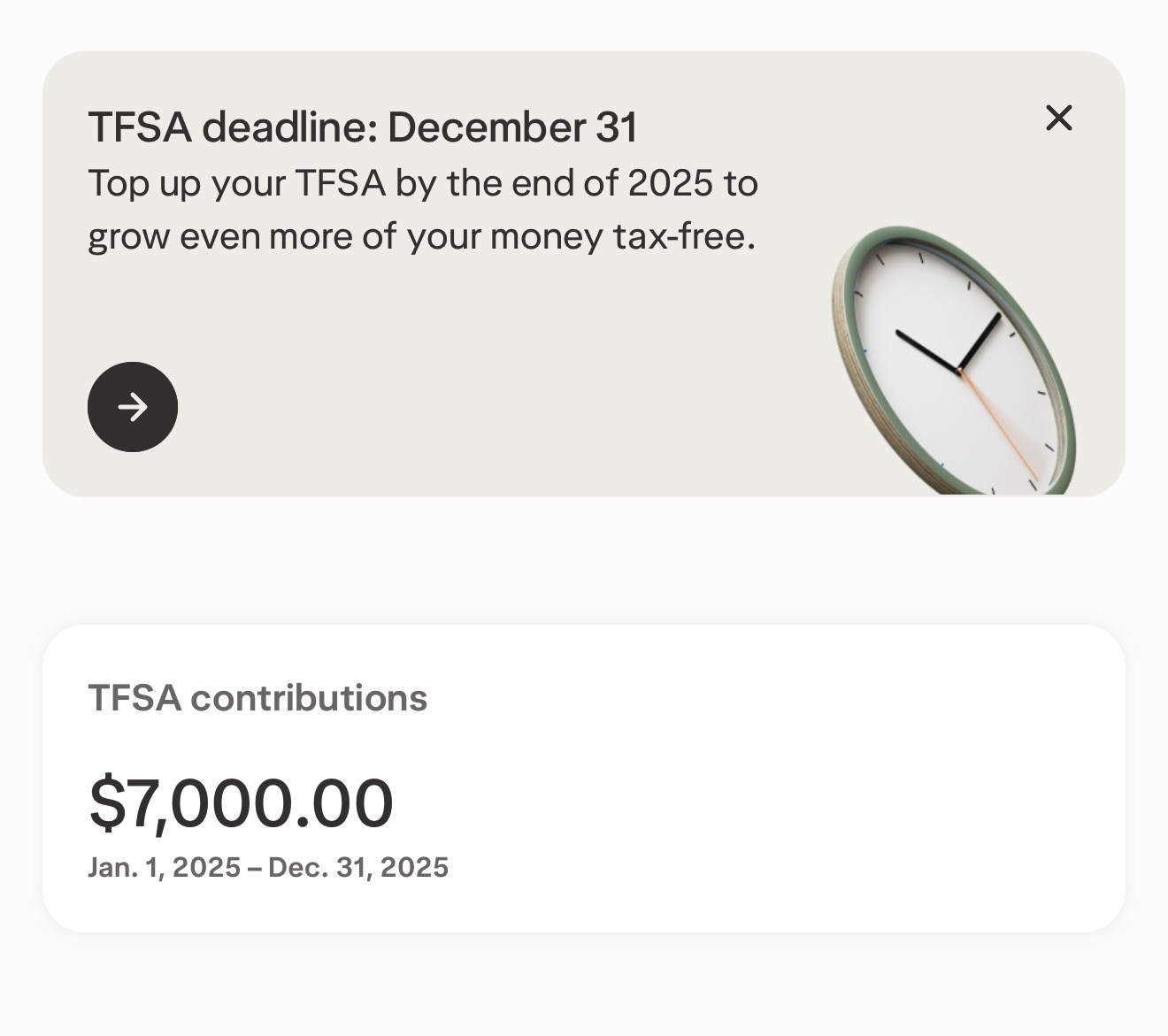
Receipts of me maxing out my Canadian TFSA contributions for 2025! Been living and working in Canada for 4 months.
I am not a financial advisor, and you should seek professional advice before making any financial decisions (need to cover myself before someone sues me or I get cancelled).
Try to Add Some Joy to Your Life
As a newcomer, you will most likely feel overwhelmed at your new life, and you may find yourself alone. I believe that you need to adapt the mindset of "I am alone, but I am not lonely." I am still in the process of establishing new social and professional circles and, if I am lucky, a new partner – I moved on my own with just my suitcases! This is not necessarily a bad thing – I find that going for jogs and also trying out new things helps a lot. Who would have thought I would find myself on a badminton court in 2025?! Use the time you have to try new things or get back into rhythms that you were familiar with in your home country. You do not need to "do the most". With time and persistence, I do believe that things will fall into place.
Take Care of Yourself
Taking care of yourself is a big part of the expat journey. This means that you need to be your own hero, cheer yourself on, support yourself, and help yourself. Take every experience as a growth experience. Remember your goals and the progress you have made. Unfortunately, in this life, no one is going to save you if you cannot save yourself. This might be rich coming from me now, given that I have not experienced major challenges yet. I am in my humble era - very appreciative of what I have now. Keep on reading those books and working on those pet projects!
Ensure your Medical Affairs are Secure for the First Few Months
If you have any pre-existing chronic medical conditions, make sure you pack enough medication to keep you going until you can see a specialist. I would also recommend that you request your doctor to send you your entire medical history. I do have an existing chronic treatment so I made sure to pack enough medication and got my medical history emailed before moving. One of the Canadian doctors here said, "you are one of the easiest patients I have had today." after seeing my full medical history files from South Africa.
To Emigrate or Not to Emigrate? Some Fair Considerations
Ultimately, there is no right or wrong answer to this question. The decision to move should be something you decide and not what content creators tell you. There is no perfect country, and one could argue that there is no 'perfect time to move'. When formulating my decision to move, these were my thoughts around the key areas I considered:
Consider Your Current Financial Standing
Before even thinking about emigrating, you need to look at your bank account(s) and your overall financial standing. Do you have more than enough funds? From my viewpoint, one should not move if any of the items below need to be executed:
- Sell your immovable property/properties to finance your move.
- Liquidate your investments (stocks, ETFs, crypto, etc.).
- Liquidate your retirement funds.
- Liquidate your business venture(s).
- Exhaust all your emergency savings to support your move.
In my view, you should ONLY consider migration if such a move does not wreck your overall financial well-being. The above list does not consider people who are fleeing wars, political persecution, or political instability - that is a special category that I cannot speak to.
Consider Your Current Career
The next item to look at is your current career. Where are you in your career? Can you afford to stomach some downward career mobility (worst case scenario)?
If my career was at its peak - for example, I was a c-suite executive, or I was a premium employee relative to the corporate food chain, or I had active business ventures, I probably would not want to move, unless there was a bigger reason to move. Whether a profession is in-demand or not does not really matter (in my view). The basic principles of supply & demand are applicable to every profession, and every profession is not immune to transitory market or economic conditions. For a better picture, please do your homework.
Consider Your Age, Family, and Overall Situation
My conservative stance on this matter came to the following points:
- The prime time to make big, cross country moves is in your early to late 20s.
- It is possible to move in your 30s and beyond, however, the risk factor starts increasing (e.g.: family, spouse, finances, various interests, etc.)
When I told my mom and family that I was leaving, there were feelings of shock and confusion. Eventually, everyone came around and my mom helped me pack and sell off my belongings.
Screw It, I am Going to Move Anyway! Analysis-Paralysis Will Keep Me Wondering
As Wendy Williams once said, "Those who wait get left on the side". You could trigger the nuclear option and run with the move. Analysis-Paralysis may have you running linear and quadratic equations, as well as refining assumptions with many statistical models to determine whether your thoughts are in the right place. This was where I invoked the notwithstanding clause – I found myself running many scenarios in my mind, trying to get the first, second and anti derivatives for my scenarios.
Final Thoughts
Overall, I think I am doing reasonably well and this new reality will sink in and feel more natural. Passing the first checkpoint (3 months in Canada) with no major hiccups is a good thing; It does indicate that even greater days are possible in the future. Having passed 3 months here means I can start "letting my hair down a bit" and relax. The Metro Vancouver region truly is magnificent, and I hope to experience more of it as time passes. I still need to go coffee shop hopping so I can rebuild my index of coffee spots and coffee roasters worth my dollars and time. I do realise that while I may have written this post from a hawkish perspective, I do believe that we should not ignore 'the basics.' I would like to thank my previous line manager and past colleague for helping me out with reference checks in July of 2025 – hopefully they both read this fun and witty post and will not forget my name. Will Canada become my new home? Will living and working in Canada show me something interesting and unrelated? Will I experience and do great things while in Canada? What I am I going to look like in a few months to years from now? Only time has the answers to those questions.
Disclaimer
No Generative AI was used to author any parts of this article. I figured that it would be fun to write something a little witty, light-hearted, and grounded in reality.
The views and opinions expressed in this post are solely mine and do not represent those of my employer, or any other affiliated entities.